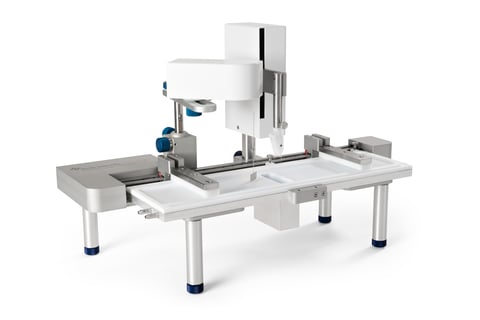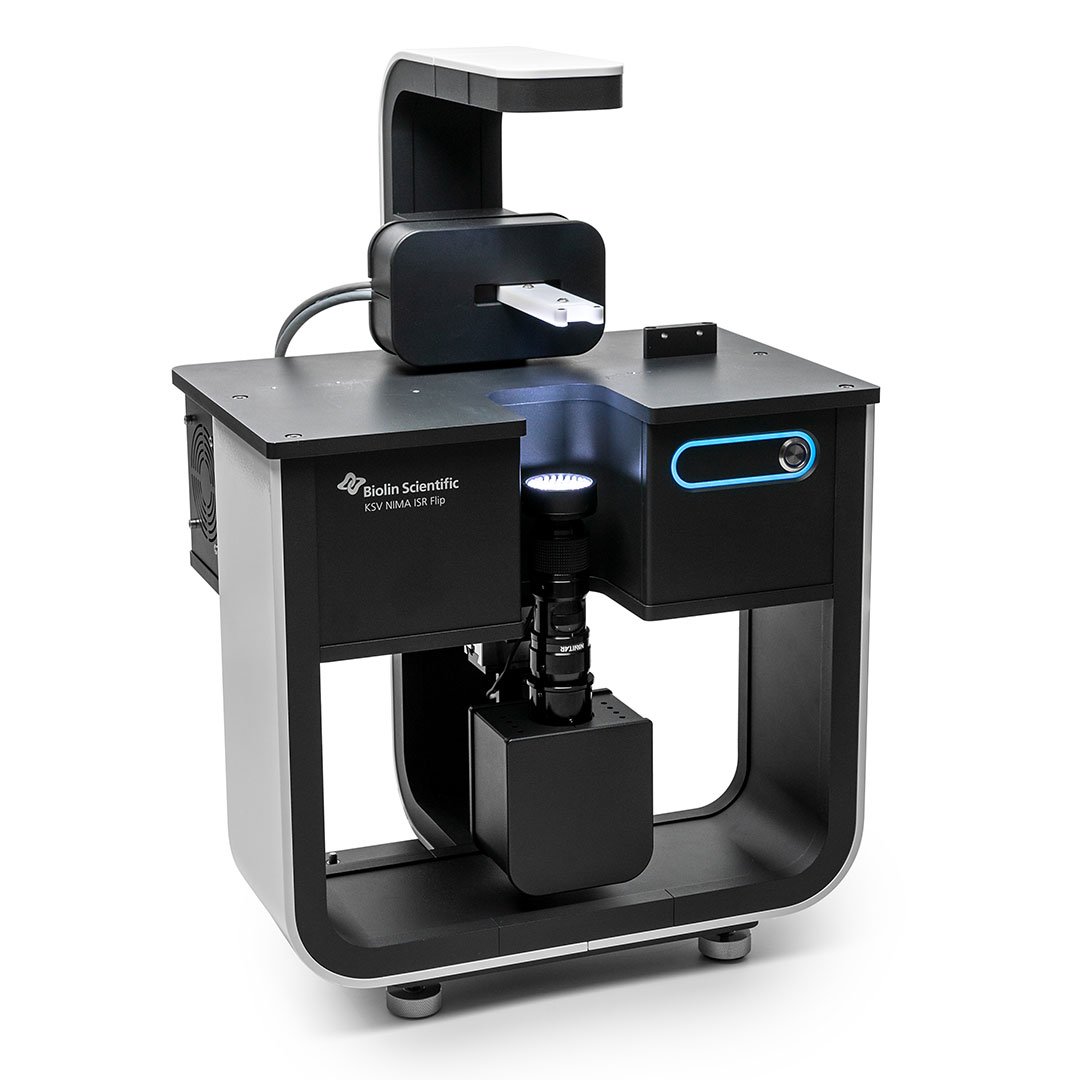
PM-IRRAS is a highly surface specific FT-IR method that is capable of detecting chemical compositions from interfacial films down to one molecule thick films. The PM-IRRAS technique allows enhanced detection on substrates and measurements from the air-water interface. Changes in the PM-IRRAS signal intensity and position can be used to infer molecular absorption/desorption behavior and kinetics, molecular packing, phase transitions, hydration, hydrogen bonding and different surface reactions in a thin film. Additionally in PM-IRRAS the properties of the polarized light can be used to determine the molecular orientation in a film.
The reported infrared absorption of the PM-IRRAS is in the range of 800 - 4000 cm-1 making it possible to detect the following:
-
Adsorption / desorption and surface reactions in mono- and multilayers
Studying interaction of biomolecules using cell membrane models can provide means to understand reactions related to drug delivery and the membrane behavior itself. These kinds of model systems are employed in several application areas, such as drug development, food technology, and biological and biochemical research.
-
Molecular-scale quantitative analysis of molecular orientation
The orientation changes of molecules at the air-water interface or at reflective solids can be detected from the PM-IRRAS peak intensity. This enables, for example, observing the effect of Langmuir film packing density as well as Langmuir Blodgett coating orientation.
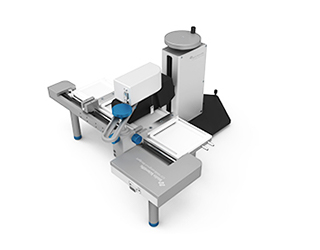
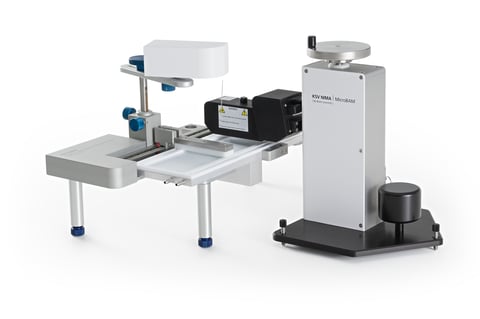
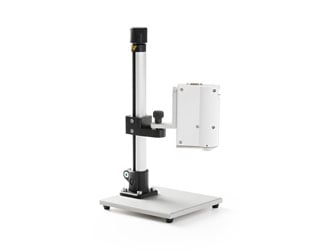
The PM-IRRAS technology allows the measuring of surface specific FT-IR spectra of materials because of the differences in the reflection of p- and s-polarized light from interfaces. The polarization modulation method almost completely eliminates background signals coming from environmental factors such as water vapor and CO2 which removes the need for protective gasses as with other IR reflection instruments. By positioning the spectrometer and detector on a goniometer above the surface the experimental setup is greatly simplified and provides you with results within minutes instead of days. This open design also allows combined use of other complementary equipment like external UV light source and temperature heater. The instrument can be positioned above a fully equipped analytical Langmuir Trough, facilitating accurate monolayer studies without restrictions.
| PM-IRRAS contains a state-of-the-art compact Fourier Transform IR-spectrometer. The spectrometer and polarization modulation unit is mounted on one arm of the goniometer with a highly sensitive MCT-detector on the other arm. The spectrometer and PM-unit operate at different frequencies enabling separation of the two signals at the detector. A resolution of 8 cm-1 makes it possible to observe the processes of interest in the monolayer. |
|
|

|
Reflectance measurement
In a reflectance measurement, the instrument delivers infrared spectra from an air-water interface or IR-reflective surface. The air-liquid measurement allows the observing of any changes in thin film functional groups at the interface. This can be structural changes due to chemical reaction, phase transition or many other phenomena. With IR-reflective samples the s-polarization disappears and allows accessing directly the molecular orientation of the coating. Due to the open design for example polymerization reactions on solid surfaces initiated with temperature or UV- light can be easily performed.
Transmittance measurement
Traditional transmittance measurements, such as studying KBr pellets, are possible due to the flexibility of the goniometer. Measuring non-modulated polarized or non-polarized IRRAS is also possible with the instrument by simply turning off the polarization.
Graph 1
The PM-IRRAS was used together with a Langmuir trough to measure two different types of floating graphene oxide layers prepared on a water subphase. The incident angle of the PM-IRRAS beam was 80° which means that in floating monolayers dipoles perpendicular to the surface show as peaks up and parallel as peaks down. The C=O stretches of the two are oriented differently (1750 cm-1) in the floating layer. The deposited layers show that the GO2 has much more complex structure, probably from having more defects in the graphene layer.
Graph 2
A DMPA (dimyristoyl phosphatidic acid) monolayer was formed at the buffer-air interface on a KSV NIMA trough with chitosan present in the subphase. The monolayer surface pressure was measured as a function of time after the injection of BLG (beta-lactoglobulin) into the subphase. First the BLG absorbed into the monolayer (section A in the isotherm), after which the BLG-chitosan complex desorption from the monolayer was observed (section B in the isotherm). PM-IRRAS spectrums were measured as a function of time after the injection which confirmed the complexation and removal of BLG from the monolayer. The change of peak positions also confirmed the complexations and the BLG signal was completely removed after 240 minutes.

Graph 3
DPPC monolayers were deposited on gold coated glass slides at different surface pressures. PM-IRRAS spectra were measured from all the samples. The monolayer packing density (surface pressure) effect was clearly seen especially at the methyl group region (~3000 cm-1). Observed peak intensity ration change indicates that the molecule orientation changes as a function of surface pressure. The same trend was also observed at the carbonyl (~1750 cm-1) and phosphate group (~1000-1200 cm-1) vibrations.
Technical Advantages
- Simple optical adjustment
Only independent angle (40o - 90o) and height adjustments needed
-> No need for adjusting mirrors to align the beam
Takes only minutes to setup an experiment
-> For other commercial IR instruments the setup time is hours!
- Extremely easy integration for any KSV NIMA LB trough
- Open design
Easy to combine with external UV light source, heater or other complementary equipment
- Peltier cooled detector
No need to use liquid nitrogen to cool detector
-> Safe and easy measurements
- Short optical path length
H2O and CO2 influence kept to a minimum
Instrument can be used in ambient environment
-> No need for protective gas environment
- Transmission measurement possibility
- Whole unit fits easily into an enclosure
Method Advantages
- Allows optical non-invasive characterization of thin films
- Suitable for many different types of interfaces
- Provides chemical and structural information:
- From different molecules and molecular groups which have distinct characteristic spectra
- Information on molecular orientation trough molecular group orientation
Technical specifications
|
top |
IRRAS:
- Spectral range 800–4000 cm-1
- Spectral resolution 8 cm-1
- Incident angle adjustment 40°–90°
- Adjustable height
PM-unit:
- ZnSe photoelastic modulator
- Frequency 100 kHz
- Selectable peak retardation wavelength
Interfaces:
- Air / water interface
- IR-reflective solid samples
- Other IR-reflective surfaces
PM-IRRAS:
- Instrument dimensions: 735mm x 461mm x 506mm(LxWxH)
The PM-IRRAS software is user friendly and allows you to quickly starting a measurement and to easily save recorded spectra. The software can be operated together with KSV NIMA LB software, allowing collection of IR spectra at strictly defined surface pressures.
Specifications and appearance are subject to change without prior notice. Biolin Scientific shall not be liable for any errors in this document.