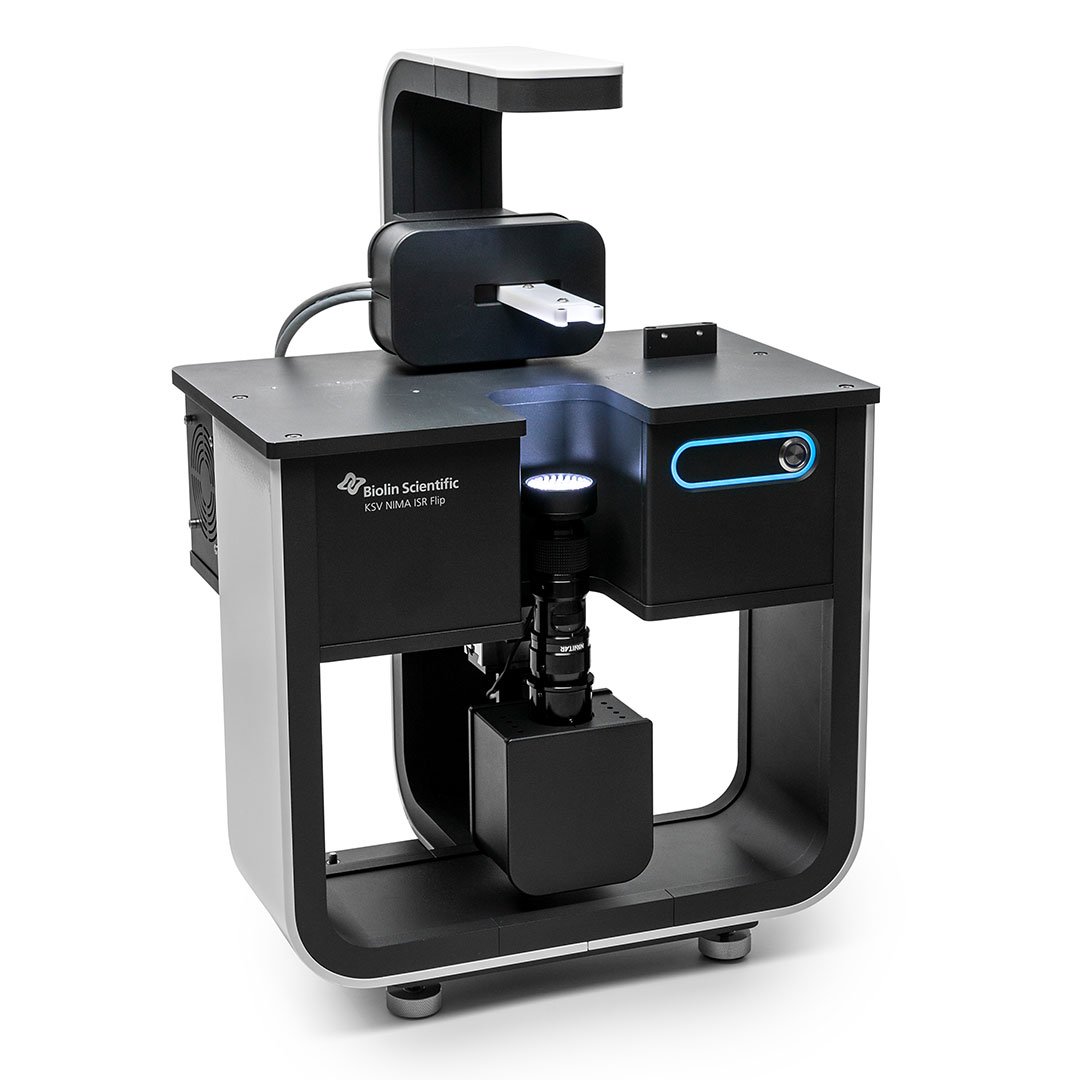
PM-IRRAS (FTIR Reflection Spectroscopy)

Polarization Modulation Infrared Reflection Adsorption Spectroscopy (PM-IRRAS) is a powerful surface specific spectroscopic method for thin films and floating monolayers. Similarly to more conventional IRRAS, the method utilizes the differences in reflectivity of interfaces for p-polarized (perpendicular to surface) and s-polarized (planar to surface) light.


At an interface p-polarized light is preferentially adsorbed during reflection, but s-polarized light is reflected almost completely, unlike in isotropic media where the adsorption is independent of polarization. So any differences in measured p- and s-polarized light can be attributed to surface specific adsorptions at the interface. In practice in IRRAS this means that four spectra need to be recorded, both p-and s-polarized spectra for background and of the sample itself. This makes the IRRAS challenging due to slightly changing environmental factors like CO2, water vapor, and instrumental noise like drifting of interferometer over time. Any of these factors changing will affect the spectral resolution, and when measuring spectra from nano to micrometer thick systems the effects can dominate over the desired signals. [1]


In PM-IRRAS the incoming IR-light polarization is modulated at high frequency, which allows the simultaneous collection of the surface specific spectra with one experiment. As the spectra are measured simultaneously, the environmental effects and instrument drift over time are almost completely removed. This is especially effective when measuring floating monolayers on water where the reflectivity is relatively small and there is a lot of interfering water vapor present during the measurement.


The PM-IRRAS method allows determining the molecular orientation of the functional groups and the whole molecule. In floating monolayers the PM-IRRAS has a strong incident angle dependency, and this can be used to determine the orientation. Also the relative peak ratios of functional groups of known orientation can be used to determine the tilt of the molecules compared to the surface. [1] An effect called “surface image selection rule” that is present in PM-IRRAS performed on good conductors leads to enhancement of perpendicular and cancellation of planar dipoles in the spectra. This can be utilized in determining the molecular orientation by comparing peak intensities, or by calculating from a theoretical spectrum. [1,2]

[1] Griffits, P and Haseth, J., Chemical Analysis 83: Fourier Transformation Infrared Spectrometry, Wiley, 1983.
[2] V. Zamlynny, I. Zawisza, J. Lipkowski, Langmuir 19 (2003) 133