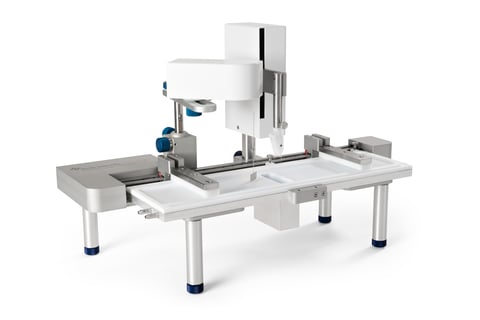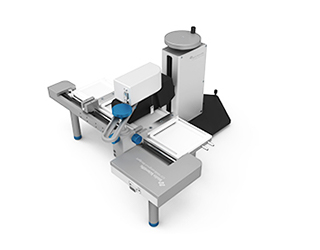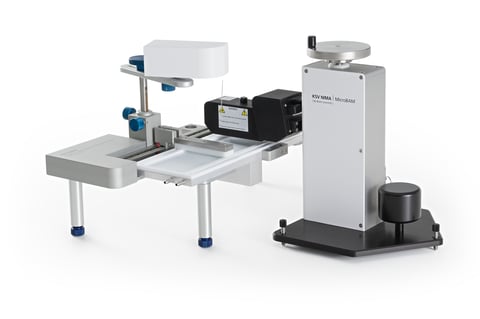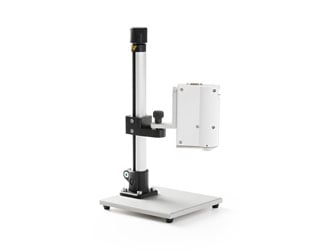
A Langmuir-Blodgett film (or LB film) can be defined as one or more monolayers of material deposited from a liquid surface onto a solid substrate by dipping the substrate through a floating monolayer at a constant molecular density. In other words, it is a film formed by one or several Langmuir films deposited onto a solid surface by vertical dipping of the solid substrate from the gas phase into the liquid phase (or vice versa).
The films obtained can be highly organized ranging from ultrathin monolayer to multilayer structures built up of hundreds of monolayers. Irving Langmuir and Katherine Blodgett founded the science of LB films early in the 20th century.

Illustration: Langmuir film, Langmuir-Blodgett depositions and Langmuir-Blodgett films of various thicknesses.
Repeated deposition can be achieved to obtain well organized multilayers on the solid substrate. There are several parameters that affect on what type of LB film is produced. These are the nature of the spread film, the subphase composition and temperature, the surface pressure during the deposition and the deposition speed, the type and nature of the solid substrate and the time the solid substrate is stored in air or in the subphase between the deposition cycles.
Density, thickness and homogeneity properties are preserved when transferring the Langmuir film onto the substrate, giving the possibility to make organized multilayer structures with varying layer composition.
Different kind of LB multilayers can be produced and/or obtained by successive deposition of monolayers on the same substrate. The most common one is the Y-type multilayer, which is produced when the monolayer deposits to the solid substrate in both up and down directions. When the monolayer deposits only in the up or down direction the multilayer structure is called either Z-type or X-type. Intermediate structures are sometimes observed for some LB multilayers and they are often referred to be XY-type multilayers.

Illustration: Various LB depositon possibilities on hydrophobic and hydrophilic surfaces.
Langmuir-Schaefer films are very similar to Langmuir-Blodgett films: the only difference is that the deposition is made horizontally, not vertically.
I want to:
- Read about Langmuir, Langmuir-Blodgett and Langmuir-Schaefer film fabrication
- Read about the KSV NIMA Langmuir and Langmuir-Blodgett Trough range
- Contact my closest KSV NIMA representative
- Email KSV NIMA